
Residency Program: Global Experience
Why Global Orthopaedics Matters
Musculoskeletal conditions affect more than 1.7 billion people worldwide and represent a leading cause of disability across all age groups. In low- and middle-income countries (LMICs), over 50 million people cannot walk, work, or thrive due to inadequate access to orthopaedic care, whether from traumatic injuries, congenital deformities, infections, or other musculoskeletal disorders.
As orthopaedic surgeons, we have both the skills and the responsibility to address these global health disparities. Whether you pursue the Global Resident Elective Program as a PGY-4, or the Global Health Track, you will gain an invaluable and unique clinical perspective, develop cultural competency, and build the foundation for lifelong engagement in global health work. Both programs are designed to provide an excellent educational experience and, for those interested, can serve as a launchpad for a career commitment to advancing musculoskeletal health globally.
Residency pathways for surgeons committed to global impact, equity, and lifelong service.
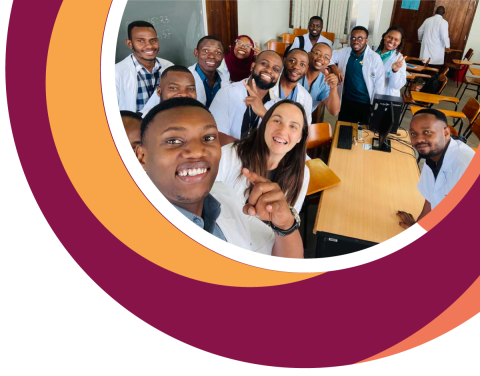
"UCSF Orthopaedic Surgery is a residency program where advanced training meets global responsibility.
Our program equips future orthopaedic surgeons to deliver high-quality care in a variety of settings, from major academic centers to underserved communities worldwide. For those that are interested in global orthopaedics, we have the faculty and infrastructure to provide education and experience in work that is focused on building capacity, promoting equity, and fostering bi-directional learning.”
– Coleen S. Sabatini, MD, MPH
Co-chair IGOT Board of Directors
Two Pathways to Global Health Engagement
UCSF’s Institute for Global Orthopaedics and Traumatology (IGOT) offers two distinct programs for orthopaedic residents interested in global health. Choose the pathway that best aligns with your career goals and level of commitment to global health work.
Global Resident Elective Program
The international rotation for PGY-4 orthopaedic residents is one of the longest-standing global rotation programs offered in North America.
The Global Resident Elective remains the most robust and sought-after program of its kind, enabling residents to learn from our global partner sites in Mexico, Ghana, and Tanzania through a one-month rotation.
This program is available to, and encouraged for, all residents and is ideal for those who want an international clinical experience and exposure to global health challenges, with the flexibility to integrate this experience into diverse career paths.
Program Goals
The overseas orthopaedic elective provides UCSF residents with an opportunity to observe and participate in musculoskeletal care in low-resource settings while contributing to ongoing educational exchange between UCSF and host institutions. This experience plants the seeds for continued global health engagement throughout a resident’s career.
Educational Objectives
- Gain an understanding of the orthopaedic conditions seen in low-resource settings, with particular emphasis on trauma
- Develop cultural awareness in a non-US
healthcare setting - Understand how orthopaedic care is delivered in limited-resource, low-technology settings
- Appreciate the monetary, administrative, and public health constraints that limit healthcare delivery in
low-income countries - Decide whether a commitment to volunteerism and service will become a priority in your professional career
Global Health Track
The Global Health Track is an intensive, longitudinal program for residents who are committed to making global orthopaedics a significant component of their career.
This track provides comprehensive mentorship, protected time for research, extended international clinical experience,
and integration into UCSF’s global health infrastructure.
Benefits
- Mentorship from world-renowned faculty through the Institute for Global Orthopaedics and Traumatology (IGOT)
- Protected time on all SFGH rotations to attend weekly research meetings with faculty mentors
- Protected time for the San Francisco SMART course to volunteer and participate
- Funding for travel to one international SMART course (once during residency) to volunteer and participate
- Extended global rotation during PGY-4: 7-8 weeks abroad (compared to 4 weeks in the elective program)
- Eligibility for UCSF Center for Health Equity in Surgery and Anesthesia (CHESA) Fellowship Program as a senior resident
Expectations
- Completion of a research project in collaboration with UCSF faculty mentor and LMIC partner(s)
- Apply for at least one OREF resident research grant for a global orthopaedic or domestic equity-based research project
- Participation in the UCSF Global Scholars Program during PGY-3 research block or research year
- Participation in quarterly global orthopaedics journal club
Choose Your Path
Choose the Global Resident Elective Program
if you want a meaningful international experience during PGY-4 with the flexibility to integrate global health into your career in various ways. This program offers exposure to low-resource settings and can serve as a foundation for future global health involvement.
Choose the Global Health Track
if you want to make global orthopaedics a significant focus of your research and career. This track provides mentorship, extensive research opportunities, and an extended international rotation.
About IGOT
UCSF’s Institute for Global Orthopaedics and Traumatology (IGOT) was founded in 2006 with the goal to eradicate the unnecessary loss of limb function by increasing the number of surgeons who can provide vital orthopaedic care in the regions that need it most.
At the core of IGOT’s programs is the Surgical Management and Reconstructive Training (SMART) course, which provides specialized training in soft-tissue techniques for orthopaedic surgeons in low-income countries, including Tanzania, Nepal, Nigeria, and Mexico. The SMART Course is a multidisciplinary program that includes didactics, hands-on sawbones workshops, and cadaveric lab sessions alongside expert orthopaedic and plastic surgeon-instructors.
Over the past 20 years, IGOT has trained over 3,000 surgeons in 55 countries worldwide.
IGOT Faculty and Leadership
Richard Coughlin, MD, MSc
Volunteerism, humanitarian work, traumatic injuries
Anthony Ding, MD
UCSF Residency Program Director; upper extremity, soft-tissue reconstruction (multiple sites)
Nicolas Lee, MD, MS
Upper extremity, soft-tissue reconstruction (multiple sites)
Madeline MacKechnie, PhD, MA
Open tibia fractures, fracture-related infections, surgical education (multiple sites)
Theodore Miclau, MD
Open tibia fractures, leadership development, bone repair basic research (Latin America)
Saam Morshed, MD, PhD, MPH
Adult lower limb trauma, open tibia fractures, fracture-related infections (Tanzania)
Coleen Sabatini, MD, MPH
Pediatric orthopaedics capacity-building/education, neglected MSK conditions in children, health equity (Uganda/multiple sites/domestic)
Sanjeev Sabharwal, MD, MPH
Pediatric limb deformity, bi-directional educational exchange (domestic)
Lauren Shapiro, MD, MS
Cross-cultural adaptation of PROs, hand surgery outreach (domestic/Costa Rica)
David Shearer, MD, MPH
Adult lower limb trauma, open tibia fractures, fracture-related infections (Tanzania)
Michael Terry, MD
Upper extremity, soft-tissue reconstruction (multiple sites)
Next Steps
Both the Global Resident Elective Program and the Global Health Track represent defining opportunities in your residency training and can launch a lifetime of meaningful global health work.
For more information about the Global Resident Elective Program, please contact
Dr. Madeline MacKechnie, Director of Global Programs at madeline.mackechnie@ucsf.edu
For more information about the Global Health Track, please contact
Dr. Anthony Ding, UCSF Residency Program Director at anthony.ding2@ucsf.edu
We look forward to supporting your journey in global orthopaedics.